

For nearly 25 years, I’ve tracked my cholesterol—LDL, HDL, triglycerides—all logged, year after year, since my medical school days. I’ve watched these numbers spike during seasons of stress and settle during calmer chapters of life. And over the past three years, I watched one number—my LDL—creep steadily upward, despite knowing exactly what I should do about it.
So on October 2, I published a reflection about my cholesterol, specifically my LDL, and an experiment I wanted to run on myself. Not a biohack. Not a 30-day challenge. Not a reinvention.
Just… an honest attempt.
A simple question: What would happen if I stopped overthinking health and actually lived it?
The results are in.
But before I get to them, I want to shine a light on something I’ve been thinking about deeply—something that sits underneath every change we try to make in our lives.
Most of the time, the biggest thing standing in our way… is us.
We complicate what was never meant to be complicated. We chase the trend, the gadget, the new supplement promising to rescue us from ourselves. We forget that long before fitness trackers and optimized routines, we were already given everything we need to be well. A body. A mind. A clearer vision of what we want for ourselves than we’re usually willing to admit.
When I started this experiment, I made a deliberate choice: Keep it simple.
Not perfect. Not extreme. Just simple.
I ate less.
I moved more.
And that’s about as detailed as it gets.
And here’s the truth—I didn’t give up the things I love. I didn’t exile joy from my life. I didn’t run from the things that make life delicious.
I love Häagen-Dazs Vanilla Swiss Almond ice cream. I mean love it. Enough to have once eaten a pint a day—something veteran readers may remember from a previous confession.
And I didn’t stop eating it now. I just ate less of it. A few scoops instead of one or two pints a week. Pragmatic, not punitive.
The same held true for movement. I wasn’t training for the NYC Marathon or trying to become an Olympic version of myself. I was simply being active—raising my heart rate, getting outdoors, letting my nervous system breathe.
But because this experiment had a clear goal—reducing LDL—I made two targeted changes:
I cut back on saturated fat. Fewer burgers and steaks, more chicken and fish. Not none. Just less.
I added more fiber through fruits, vegetables, and a morning fiber supplement.
I also started eating a small handful of almonds before meals because plant sterols can help lower LDL. A tiny change, over and over again. And when it came to resistance training—something I’ve been doing since I was 17—I didn’t reinvent the wheel. Two to three sessions a week. Forty-five minutes. Nothing heroic.
And I cut down on alcohol. Not entirely—just less.
What happened next surprised even me.
LDL dropped 14.3% (now in desired range)
Total cholesterol dropped by 11.2% (now in desired range)
Non-HDL down 13.5% (now in desired range)
LDL small particles dropped 61% (now in desired range)
LDL medium particles dropped by 50% (now in desired range)
HDL held stable and in the desired range
LDL/HDL ratio dropped by 16% (in low-risk range)
Triglycerides held stable and in the desired range
Apolipoprotein B (ApoB) dropped by 12% (nearing desired range)
Apolipoprotein A1 (ApoA1) in the desired range
ApoB/ApoA1 ratio in the desired range
Markers of inflammation—hs-CRP, fibrinogen, homocysteine—all in desired range
Vitamin D up 110% (I took a 5,000 IU supplement)
Omega fatty acids up 14% (now in desired range)
Total and free testosterone: Stable and in the desired range
These are not small shifts. They’re meaningful, measurable changes—inside of 90 days—driven by choices that required almost no complexity, no special equipment, and no heroic discipline.
Here’s the most important part of this entire experiment for me.
I could’ve taken a pill.
I’m 99.99% certain that if I started a cholesterol-lowering medication, my LDL would’ve plummeted. Quickly. Cleanly. Problem solved.
Or… is it?
I don’t believe the problem would be solved at all. In fact, I think the real problem would remain untouched.
We get blinded by the number. We obsess over the lab value. But the number is not the problem—it’s the consequence. It’s the echo of hundreds of small, accumulated behaviors. And if I take a pill, those behaviors—the true root—don’t change. They don’t improve. They don’t evolve. They simply get covered up.
Which brings me to a hypothesis I’ve been thinking a lot about:
We’re far better off living with a slightly elevated LDL and healthy behaviors than with a medically lowered LDL wrapped around an unhealthy lifestyle.
Disclaimer time: To be clear, none of this is medical advice. This is my personal framework, based on my own life and my own experiment. For medical questions or concerns, please contact your doctor. There are absolutely lab values, like blood glucose in diabetes or dangerously elevated blood pressure, and many others that need immediate intervention because the long-term consequences are real and irreversible.A pill can change a number.
Behavior can change a life.
And this is where I think we often get trapped. The shortcut—while helpful in some cases—can also prevent us from facing the reality staring back at us (like it was for me). When we medicate the number, we quiet the signal. We silence the messenger. We bypass the uncomfortable but necessary work of the behavioral change itself.
But the behavioral change is the true intervention.
It’s the root.
It’s the leverage.
It’s the part that affects not just LDL, but everything else that makes us who we are—our energy, mood, cognition, resilience, longevity, relationships, confidence.
This is the paradigm I want to shine a light on.
Because lowering a number with a pill may bring relief…
But raising the standard of how we live brings transformation.
And here’s the part that also matters:
I still enjoyed my life.
I didn’t white-knuckle my way through these months. I didn’t punish myself. I didn’t abandon the simple pleasures that make a day feel like a day.
I just became deliberate.
And that’s a takeaway.
Not the numbers. Not the science. Not the macros or the supplements.
But the reminder that small, intentional choices—repeated consistently—are often enough to reshape our lives . We don’t need to uproot everything. We just need to shift a few things with meaning.
Of course, your path will look different. Everyone’s body is its own universe, with its own rules, and its own genetics. This was my N=1 experiment. But I hope, somewhere in these 90 days, there’s something useful for you.
And I want to say thank you. Truly.
One of the reasons I stuck to this plan is because I told you I would. Accountability—quiet, steady, communal—matters more than we realize. A big part of my consistency came from knowing I had committed to sharing these results with you.
As an epilogue, I should confess: the week after my labs were drawn was Thanksgiving. I ate enormous amounts of food and drank liters of wine. Truly heroic quantities. But when the holiday ended, I slid right back into my rhythm—and it reminded me of something Michael Pollan wrote nearly two decades ago:
Eat food. Not too much. Mostly plants.
And my corollary: Move your body. Go for walks. Lift something heavy a few times a week.
Oh, and love generously. Relationships are the real nourishment in this life.
Welcome to this week’s Three Book Thursday.
1. Nutrition
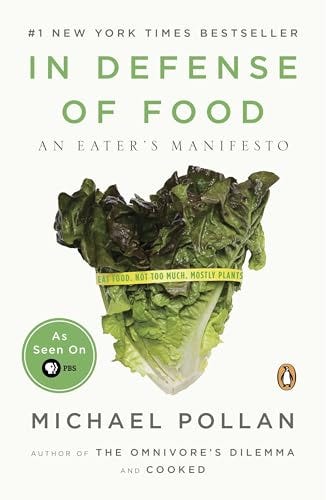
In Defense of Food: An Eater’s Manifesto
Summary
Michael Pollan’s In Defense of Food is a reminder that we’ve made one of the most human acts—eating—far too complicated. In a culture obsessed with nutrients, labels, and the next magic health fix, Pollan brings us back to something beautifully simple: real food has always been enough. And when we choose it—when we slow down long enough to taste, to share, to be present—we don’t just eat better. We live better.
Pollan’s message isn’t about restriction or perfection. It’s about reclaiming clarity. His seven-word prescription—Eat food. Not too much. Mostly plants.—isn’t a diet; it’s a philosophy of intention. It challenges us to question the systems shaping our habits and to return to fundamentals that actually work. This book is a call to simplify—to build a foundation of health, energy, and presence that supports everything else we’re trying to do.
Quote: “The more we worry about nutrition, the less healthy we seem to become.”
Principle: You don’t need to track every nutrient—you need to trust in the wisdom of foods that have nourished humans for generations.
Insight: To reclaim control of eating is to reclaim control of living.
Author: Michael Pollan
Themes: Nutrition
Michael Pollan’s book is new to 3BT, but it sits comfortably alongside several others that speak to today’s theme. If you’re looking to go deeper, here are a few that have shaped my own thinking:
Genius Foods: Become Smarter, Happier, and More Productive While Protecting Your Brain for Life
Atomic Habits: An Easy & Proven Way to Build Good Habits & Break Bad Ones
Four Thousand Weeks: Time Management for Mortals
Younger Next Year: A Guide to Living Like 50 Until You’re 80 and Beyond
Outlive: The Science and Art of Longevity (great insights, avoid the complexity)
Digital Minimalism: Choosing a Focused Life in a Noisy World
Please let me know what resonated with you in today’s 3BT (if anything). None of us have this figured out - not fully, not permanently - and I’m always happy to share more of my own experiments, insights, and missteps if they add value to your journey.
Always ❤️📚💡

Three Book Thursday is free, but there are many costs to create these posts each week. So, can you do me a favor?
If you find value here, please support the newsletter.
Please share Three Book Thursday with a friend, college, family member, or post it to your socials. I’m working hard to grow this audience, but let’s be honest—you’re probably better at it than I am.
Or, do both!